
Most Canadian founders don’t realize how vulnerable their business becomes when succession planning is delayed. You spend years keeping things stable, managing cash flow, supporting your team, and solving daily problems. But when it’s finally time to step back, many owners face the same tough truth: the business is ready for the next stage, but the transition isn’t.
That gap creates real risk. Late planning forces rushed decisions, weakened negotiating power, increased tax costs, and turned the handover into a reactive process. Even strong companies lose value when the groundwork isn’t in place. Starting early protects what you’ve built, keeps your financial future intact, and ensures you stay in control of what happens next.
Why Succession Planning Matters
Succession planning protects your business, your family, and your legacy. It keeps your company stable when ownership changes hands, whether through retirement, sale, or family transition.
Without a plan, change can bring confusion, high taxes, or a drop in business value. With the right strategy, you stay in control and ensure a smooth handover.
A strong plan helps you:
- Maintain your company’s value and daily operations
- Reduce tax costs during ownership transition
- Support your employees and customers through change
- Prevent family conflict by setting expectations early
Succession planning isn’t a one-time task. It’s a long-term protection for everything you’ve built.
Example:
A Toronto family bakery lost nearly 18% of its business value during a rushed sale simply because financials and processes weren’t documented. Proper planning could have preserved most of that equity.
What Is Succession Planning?
Succession planning is the process of deciding who will own or lead your business when you step back. It creates a roadmap that secures your company’s future and ensures leadership continuity.
At its core, it means you:
- Set clear goals for your business and personal future
- Choose a successor (family member, key employee, external buyer)
- Plan your tax and legal structure
- Build a timeline that fits your financial and personal plans
The earlier you begin, the better the outcome. Starting five to ten years ahead gives you time to grow value, train your successor, and align finances.
Succession planning means choosing who takes over and deciding how the transfer happens without risking your wealth.
Succession Planning Timeline (5–10 Year Roadmap)
| Timeline | Key Actions |
|---|---|
|
5–10 Years Before Exit |
Identify potential successors
Begin long-term tax and retirement planning
Review corporate structure and share setup
Document operations and key processes
Improve financial reporting and profitability |
|
3–5 Years Before Exit |
Conduct a business valuation
Strengthen financial statements
Implement leadership development
Start estate planning discussions
Review QSBC eligibility for LCGE |
|
12–24 Months Before Exit |
Finalize your preferred exit option
Begin buyer/successor financing discussions
Prepare due diligence documents
Review tax projections for each scenario |
|
0–12 Months Before Exit |
Negotiate the transfer
Finalize legal documents
Execute leadership handover
Communicate transition plan internally and externally |
|
Post-Exit (0–24 Months) |
Provide limited consulting support
Complete final business and tax filings
Fully transition out of operations |
How to Value a Business in Canada
Before transferring ownership, you need to know what your company is worth. This process, known as business valuation, determines fair market value based on assets, income, and market conditions.
Common Methods for Business Valuation:
- Income approach: Based on the company’s profitability.
- Asset approach: Adds total assets and subtracts liabilities.
- Market approach: Compares your company to similar ones recently sold.
These methods help you understand the real value of your business and set fair expectations. Working with a Chartered Business Valuator (CBV) ensures compliance with CRA standards and prevents disputes.
A CBV reviews your financial statements, adjusts unusual expenses, and applies proven valuation methods. The result is a reliable estimate of what a genuine buyer would pay.
AnalytIQ offers expert guidance through our business advisory & strategic planning service to help ensure your valuation is accurate and your next steps are well-informed.
Example:
A small HVAC company earning $350k in profit may be valued at 3–4× earnings. The exact number depends on stability, contracts, and assets. This shows how expert value can strongly influence negotiations.
Tax Implications of Selling or Transferring a Business
Selling or passing on to your business always triggers tax consequences. The goal is to understand them early, so you keep more of the money you’ve worked for. Here’s the simplest way to think about the tax pieces involved.
1. Capital Gains Tax (Most common for share sales)
When you sell the shares of your business, the profit you make is called a capital gain.
Simple example:
You sell your shares for $1,000,000.
You originally invested $300,000.
Your profit is $700,000.
Only part of that gain is taxable.
Why it matters:
If you qualify for the Lifetime Capital Gains Exemption (LCGE), much or even all of that gain could be tax-free.
This is the biggest tax benefit available to small business owners when exiting.
2. Corporate Tax (Mainly affectsasset sales)
If you sell business assets instead of shares, the company pays tax first, and then you may pay tax again when money comes out of the company.
Example:
Your company sells equipment for more than its book value.
The company pays tax on that profit.
Then when you withdraw the money, you pay personal taxes too.
Result:
This “double layer” of tax is why many owners prefer share sales.
3. Dividend Tax During the Transition
Some owners pay themselves dividends while they prepare the business for sale. If not planned well, this can push income into a higher tax bracket.
Example:
A $50,000 dividend in the same year as a business sale could increase your personal tax rate and reduce your final take-home amount.
Planning helps you:
- spread income
- avoid unnecessary tax brackets
- keep more of your retirement savings
4. Family Transfers (Special rules apply)
Passing a business to your children or grandchildren has unique tax rules under Bill C-208.
Simple explanation:
If structured correctly → taxed like a sale to an outside buyer (often lower).
If structured incorrectly → treated like a dividend (much higher tax).
Example:
A $600,000 sale to your child could be taxed at:
- a low capital gains rate if planned properly, or
- a high dividend rate if not.
This is why family transitions require careful planning.
5. GST/HST on Asset Sales
When selling assets, GST/HST may apply unless a specific election is filed.
Example:
If you sell equipment without planning, GST/HST may apply.
If structured correctly, the buyer may be able to acquire the business without GST/HST.
A quick conversation with your advisor prevents this mistake.
Tax Reliefs for Business Owners
Planning ahead can reduce what you owe and protect your retirement funds. Knowing which reliefs, you qualify for ensures a smoother, more profitable transition. Key tax reliefs and strategies include:
- Lifetime Capital Gains Exemption (LCGE):
Owners of a Qualified Small Business Corporation (QSBC) may shelter over $1 million (indexed for 2025) of capital gains from tax when selling shares. - Family Transfer Rules (Bill C-208):
Selling shares to children or grandchildren may allow you to use a lower tax rate instead of paying standard dividend tax. - Estate Integration:
Transferring shares via a will or trust ensures taxes are applied only once, avoiding both estate and capital gains taxes on the same assets. - Tax-Deferred Share Transfers (Rollovers):
Allows gradual transfer of ownership without triggering immediate taxes. This keeps more cash in the business and gives the new owner time to pay over a set period.
Integrate your exit plan with proactive tax planning to reduce tax costs and preserve your business’s long-term value.
Quick Breakdown of Succession Planning Realities
| Factor | Share Sale | Asset Sale |
|---|---|---|
|
Tax for Seller |
Often lower (LCGE eligible) |
Often higher |
|
Tax for Buyer |
Less favourable |
More favorable |
|
Transfer Process |
Simpler |
More complex |
|
What’s Included |
Entire business |
Selected assets |
|
Best For |
Family transfers, MBOs, investors |
Liquidation, partial exits |
Exit Strategy Options
Planning your exit is one of the most important financial decisions you’ll make. The right strategy depends on your goals, finances, and family or team dynamics. A carefully chosen plan can protect your wealth and ensure a smooth transition. Some key exit strategy options include:
Family Succession:
Train and prepare relatives to take over leadership, keeping your vision alive and the business in the family.
Management Buyout (MBO):
Let key employees purchase ownership, maintain continuity, and reward loyal team members.
External Sale:
Sell to an outside buyer or investor at fair market value, unlocking the full financial value of your business.
Merger or Acquisition:
Combine with another company for strategic growth or a planned exit, benefiting from scale or market positioning.
Wind-Down:
Close and liquidate if continuation isn’t practical, converting assets into cash while managing obligations responsibly.
Plan a tax-efficient business exit with AnalytIQ, protecting your company’s value and your team. Discover more on our business advisory services page.
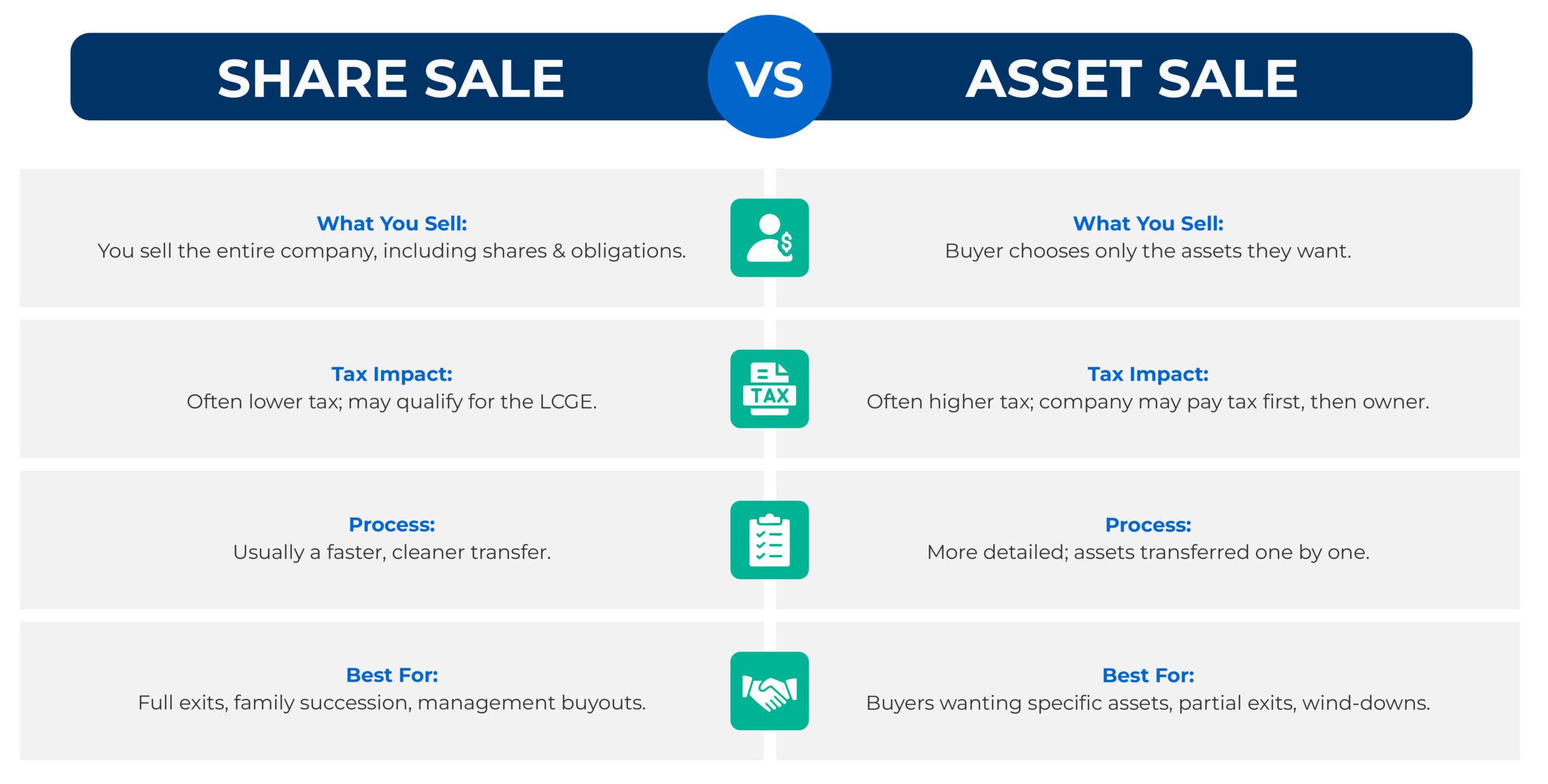
Share Sale vs. Asset Sale: What’s the Difference?
When planning your business exit, one of the biggest decisions is whether to sell the entire company or specific assets. Each option comes with different tax outcomes, transfer steps, and buyer expectations.
This simple comparison helps you see the difference briefly:
Quick Takeaway
A share sale typically benefits owners looking for a clean exit and stronger tax outcomes.
An asset sale works best when a buyer only wants certain parts of the business, or the company will not continue as-is.
Mistakes to Avoid
Even entrepreneurs with years of experience make costly mistakes when preparing to exit. Many underestimate timelines, ignore valuation issues, or overlook tax impacts. Some wait too long to prepare, which reduces options and weakens negotiation power. A structured plan protects value, lowers risk, and creates a smoother transition.
Here are the most common mistakes and how to avoid them:
- Delaying the plan: Waiting until retirement limits your options. Start at least five years ahead.
- Skipping expert advice: Include an accountant, lawyer, and valuator from the start.
- Ignoring tax strategy: Poor planning can reduce your sale proceeds significantly.
- Poor communication: Keep your family and management informed to prevent confusion and conflict.
- No backup plan: Prepare for illness, market changes, or sudden offers.
Many of these issues show up in real businesses. Owners delay decisions, teams feel unsure, and buyers can’t move forward because the groundwork isn’t there.
A simple example illustrates this:
“My boss is 75 and wants to retire but never made a succession plan. I’d love to buy the business, but I have no funding.
— Buy-a-Business, r/Entrepreneur, 2024
This situation highlights how inaction can stall opportunities and create uncertainty. By starting early, seeking professional support, and keeping your team informed, you can avoid these pitfalls and create genuine opportunities for the next generation.
FAQs
What is succession planning for a small business in Canada?
Succession planning decides who will own or lead your business when you step back. It also sets the tax and legal structure and a timeline for the transfer.
When should you start succession planning for a Canadian small business?
Start 5 to 10 years before exit. It gives time to train a successor, improve reporting, and plan taxes.
How do you value a business in Canada before a succession plan?
Common methods include income, asset, and market approaches. A CBV helps align valuation work with CRA expectations.
What taxes apply when selling or transferring a business in Canada?
Common areas include capital gains on share sales, corporate tax on asset sales, dividend timing, Bill C-208 rules for family transfers, and GST/HST on asset sales.
Plan Your Next Steps with Expert Support
Succession planning protects everything you’ve worked hard to build. It secures your wealth, your legacy, and the future of your business. The process takes time, and the right support makes it easier. With proper guidance, you can transition ownership smoothly and avoid costly mistakes.
AnalytIQ helps Canadian business owners create tax-efficient exit plans. We guide you through valuation, tax planning, and each step of the transition. You can retire with certainty and peace of mind. Build a tax-efficient exit that protects your retirement. Book your free consultation today!
Succession planning helps Canadian small business owners reduce tax risk and control who takes over. Start 5 to 10 years early. Get a valuation, map tax outcomes like LCGE and family transfer rules, then pick an exit strategy that fits.